THE SECRET HISTORY OF SOUTHEND-ON-SEA
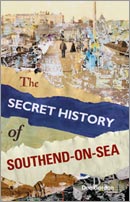
BOOK DETAILS
- 191 pages
- The History Press, Feb 2014
- £9.99 RRP
- Available for purchase from Amazon, Waterstones, W. H. Smith, The History Press and from all good bookshops
- Also available in Kindle format, £4.79
BOOK REVIEWS
♦ “The book is so full of interesting, golden nuggets that it is difficult to select any one of them to emphasise how good the book is… I understand the enormous amount of research that Dee Gordon must have put into this very informative book to bring it to the market place, and I would strongly recommend reading it to obtain its full flavour.“
(The Woman Writer, Review – August 2014 issue)
♦ “A book about the secrets that the town holds … focuses on a brief history of the town, as well as secret places and people that have lived in the town… finding secrets isn’t the easiest thing to do.“
(Yellow Advertiser – 07.03.2014)
♦ “From indiscreet MPs to ‘crop circles’ and a horrific murder that inspired Hitchcock – Dee’s dug it all up in her book… Dee has managed to discover not just the existence of mysteries, but their solution. For instant, diligent trawling through back copies of the Southend Standard identified the truth behind a mystery object in Southend Museum – and in historical terms, the solution is a sensation.” (Read the book to find out more!)“
(Southend Echo – 21.02.2014)
BOOK EXTRACTS
A FEW EXAMPLES OF THE SECRETS IN THE SECRET HISTORY OF SOUTHEND
A secret location on the river at Hockley became known as Brandy Hole, where casks of spirits could be sunk for later collection, and there was another hiding place on Thundersley Common (both on the outskirts of Southend-on-Sea) offering places to stash silk and tobacco as well as liquor. Apart from brandy, it seems that Holland’s – Dutch gin – was a favourite. One enterprising young 18th century entrepreneur set up his own secret still in Hockley to make brandy at a time when the demand for illicit spirits outstripped supply. These home-made supplies were taken by the cartload to Hullbridge (where he lived and where he had contacts ready and waiting to buy) and although the customs officials caught on, he escaped capture. They were watching the river when they should have been watching the road.
Writer H.G. Wells’ affair with the much younger (by 26 years) Rebecca West was concealed from all but his wife during their ten year relationship from 1913 to 1923. Rebecca moved from London in February 1917 with their two-year-old son, Anthony, and lived on Marine Parade in Leigh-on-Sea for three or four years (“Southcliffe” – described as having magnificent views of the Thames Estuary), financially assisted by the successful author. Anthony enjoyed the open surroundings with their public gardens, and even, given his age, the sound of gunfire. Rebecca was fond of walking, admiring the views, though she did make plenty of trips to London. The area, however, was in the firing line for German air raids, and Rebecca became nervous when Zeppelins flew overhead and anti-aircraft guns kept her awake at night. When they narrowly missed being caught in a bomb attack in Southend, Anthony was sent to a private school back in London – again, not the wisest of moves, and the school moved out of London as the bombing escalated. [Mother and son were reunited after the war (by 1920), settling in the capital, and Rebecca achieved great acclaim in her own right both here and in the U.S.A. as a novelist and as a political writer.]
Pigeons were useful carriers of secret information, with no threat of them “squawking”. During the Second World War, The Royal Signal Corps established a breeding establishment for carrier pigeons at the Salvation Army Colony in Hadleigh, with training carried out on Hadleigh Downs, west of Southend. Up to 500 birds at a time were packed in containers and dropped over occupied Europe with secret messages between the allies and resistance groups. It is also rumoured that the French Maquis had their own pigeons in cotes alongside The Anchor public house at Hullbridge, just north of Southend: the landlord sent messages brought back from France to British Intelligence in London, with the help of the railway guards en route.
Everyone has heard of John Bunyan’s Pilgrim’s Progress, even though it was published back in 1678. It is a piece of classic English literature, still in print, studied by scholars and juveniles, a Christian allegory considered of huge significance in religious literature. It has been translated into 200 languages, been an opera, a musical and a film. But, and it is a big but, in 1601, South Shoebury parson, Arthur Dent, published The Plaine Man’s Pathway to Heaven, the tale of a man’s journey from this world to the next, related as a conversation between four people. Sounds familiar? John Bunyan himself admitted a fondness for Dent’s book, which was one of the only two books which made up his penniless wife’s marriage “portion,” and which he read with her. Dr John Brown, an authority on Bunyan, stated that the resemblance between Dent’s work and Bunyan’s is “too close to be merely accidental”. Although he did feel that Dent’s book was inferior, being “wearisomely heavy and shallow” it still ran into 24 editions by 1637. [Dent, the vicar of St. Andrew’s, was an interesting combination of intellectual theologian and down-to-earth preacher who preferred his sermons full of “shovels, spades and plain truths” suitable for his farmer-led congregation.]
The Beecroft Art Gallery in Westcliff-on-Sea has a fine painting of The View of the Rialto Bridge, Venice, which can be dated between 1720 and 1768. Bearing in mind that the Venetian artist Canaletto was working at that time, and was renowned for views of his native city, this painting was attributed to the great man himself. Although, in 2000, an art expert was convinced of its authenticity, nothing could be proved as it is un-signed. Sadly for the Beecroft, however, another expert – from London’s National Gallery – has gone on record as believing that the painting is by one of Canaletto’s “later” followers. The good news is that the gallery did not pay a fortune for the painting – it was bequeathed by Leigh solicitor Walter Beecroft in 1961, the man who had donated the building, along with his art collection.
In the 1940s, Southend-on-Sea was often awash with professional criminals, referred to by some as Southbent-on-Sea, the early equivalent of the Costa del Sol before air travel took off, literally. One example was a career criminal with a record for armed robbery, Bill Walsh, who supplemented his ill-gotten 1947 income by £500 – a goodly sum in 1947 – as a result of a short stay in the town, robbing, burgling and pick-pocketing in the pubs. Leaving behind a couple of clues in the form of a revolver and a diamond watch, he nevertheless managed to get away from the legendary Detective Chief Inspector Bob Fabian “of the Yard”, returning to London – and capture. Walsh’s girlfriend was attractive blonde Doris Hart (a Betty Grable type), Southend born and bred, who worked in a café on the seafront, and she had her fifteen minutes of fame as a gangster’s moll, appearing on the front pages of the national press.
When William Waight died in 1791, he was buried in Hockley churchyard, but in an unusual spot. He left instructions in his will that he wanted to be buried outside the Elizabethan porch of the church, so that everyone who went to church would walk over his grave stone. The reason? To quote William himself: “People have trampled all over me in life, so they might as well do so in death.”
A book full of intriguing information on the incredible residents, visitors and events that have played a part in Southend’s story.
Southend-on-Sea, the largest town in Essex, has had an amazingly rich history,and this book collects together hundreds of little-known facts and anecdotes that will make you see the town in a new light.