STRUGGLE AND SUFFRAGE IN SOUTHEND-ON-SEA: WOMEN’S LIVES AND THE FIGHT FOR EQUALITY
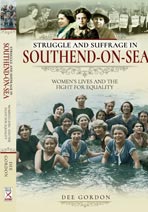
BOOK DETAILS
- 131 pages
- Pen & Sword Publishers, April 2019
- £14.99 RRP
- Available from Amazon, publisher and and from all good bookshops
BOOK REVIEWS
♦ “Packed with facts, very interesting!
An amazing book, well written and full of snapshots of what it was like to be a woman living in Southend-on-Sea, a century ago. Packed with interesting anecdotes, it is a real eye-opener and a must-read for any woman unhappy about life in the 21st century!! Highly recommended.”
(Amazon UK review – 28.06.2019)
BOOK EXTRACTS
While Southend-on-Sea, like many seaside towns, may not have been at the forefront of the struggle for suffrage and equal rights in the lives of women between 1850 and 1950, there are surprisingly famous names linked to the town and its women. Novelist Rebecca West, living in nearby Leigh-on-Sea during the First World War (and her lover, H.G. Wells) played a key role in the suffrage and feminist movements and in women’s entry into the scientific and literary professions. Princess Louise, a visitor to the town, was known to be a feminist, regardless of her position, and Mrs Margaret Kineton-Parkes (founder member of the Women’s Tax Resistance League and involved in the Women’s Freedom League) gave a number of talks to the town’s female population. The most high profile of local residents was Mrs Rosa Sky, the one-time Treasurer of the Women’s Social and Political Union and an active member of the Women’s Tax Resistance League, but others were quietly active behind the scenes.
However, this book is not about the distinguished and illustrious, it is about women from all classes, from all kinds of backgrounds, who entered the world of business, who rebelled against the traditional roles of mother, home-maker or domestic servant. It is about women struggling to come to terms with changes at home, in marriage, in education, in health care and in politics. It is the first to look at these issues as they impacted on a town whose population and visitors were growing in line with the expectations of its female population.
***
In 1902, a new technical college at Victoria Circus was opened by Lady Warwick who had been running a school in science and agriculture at her estate near Chelmsford. She was interested in schools funded by local taxes and open to girls as part of a wider movement for higher education and entry to the professions by women. There was also some practical – if predictable – instruction for young women given at a Special Instruction Centre in Queen’s Road where Cookery and Laundry were on the agenda in 1908. However, early discrimination within female education continued – for instance, in 1914, some girls at Alexandra College were withdrawn from classes in ‘vigorous subjects’, in case they became ‘unwomanly’. At least by then girls had access to tennis and cricket and to a gym which had been added in 1913. Things were moving on from an emphasis on needlework, which had been regarded as an essential for all classes of female – to sew and repair their own clothes, to save money, to make toys or samplers or household linen.
***
In 1891 Where To Buy At Southend was published anonymously and, in part, acted as an early vehicle for complimentary reviews of businesses being run by local women. Mrs Purdy is described as having the ‘happy knack of making everyone feel quite at home’, at her boarding establishment on Westcliff Parade, Westward Ho (now a block of flats), although the manageress of this establishment was in trouble in May 1915 when she was fined for failing to obscure indoor lighting. Compliments were also paid to Mrs Edwards, who ‘conducted’ the Cigar Stores at 70 High Street and offered ‘the anticipation of a pleasant and warm afternoon on the pier … armed with a newspaper or book and above all … a favourite pipe heavily charged with some of the excellent tobacco’ obtained there. This latter establishment was ‘well appointed in every respect’ with quality products for ‘the most exacting connoisseur or the most fastidious smoker alike being anticipated in its comprehensive selection’, with all the necessary ‘requisites [available] at the most reasonable cost’, including, ‘cigar holders, pouches, match cases, cigar cases’, for residents and visitors interested in ‘extracting pleasure [from] the fragrant weed [who] cannot err in doing business with Mrs Edwards’.
***
As early as 1861, Mrs Beeton was writing that ‘a housewife’s badly cooked dinners and untidy ways’ were a fruitful source of family discontent. She does not mention a shortage of food, however, which was addressed at this time in Southend by a growing trend for keeping chickens where a backyard was available, and by growing herbs or a few vegetables if there was access to a couple of square metres of earth. When food-laden ships were destroyed by German action during the First World War, the reliance on imports began to rear its head, and much available land was then used to grow crops. The hockey pitch at Southend High School for Girls was used to grow vegetables, with the wartime headmistress spending part of her holidays hoeing turnips. Allotments became particularly popular during and after the First World War, with working girls giving up their spare time to cultivate land or help out at local farms.
***
In the mid-nineteenth century, Southend-on-Sea was regarded as a particularly healthy place to live, aspiring to be a spa town as publicised by visits from Queen Caroline and Princess Louise some years before. Nazareth House in London’s Hammersmith sent their most infirm, or incurable, children to benefit from the sea air at the home which they had opened in Westcliff Parade in 1873 as a place of rest and convalescence for not only sick children but other sick members of the congregation, including the elderly. Demand soon outgrew the building, necessitating a move to an old manor house, Milton Hall, in London Road after a couple of years. Local people contributed bread, meat, groceries, straw for bedding, and material for clothing – and a cow.
***
Southend’s famous pier, a popular tourist destination since its first primitive wooden format in the 1830s (but extended and improved over the years), was offering little more than a penny photo machine ‘popular with the ladies’ by 1892. Predictably, perhaps, complaints were made to the Pier Committee about ‘the nature and titles’ of the pictures being exhibited in the Mutoscopes on the pier in 1901 (e.g. What The Butler Saw). From 1898 to 1905, there was an added attraction on the seafront: the Warwick Revolving Tower which councillors’ wives were too scared to go up in – partly the height (150ft) with views at the top that made them nervous, and partly the fact that it acquired a reputation for breaking down.
***
In Southend, and especially in the nineteenth century, women were more passive than their famous counterparts in the big cities. Middle-class women, nevertheless, would have been aware of the mouthpiece of feminism commencing publication in 1857 (The Englishwoman’s Journal); of the unfair Matrimonial Causes Act the same year which denied a wife (not a husband) the means to divorce on grounds of adultery alone; of the beginnings of organised campaigns for women’s suffrage, and of the first (defeated) Women’s Suffrage Bill in 1870. At this time however, the local press and local journalists were still focusing on the more familiar female role. When Queen Victoria’s daughter, Princess Louise, stayed in Southend with her husband (the Duke of Argyll) in 1873, the newspapers were only interested in reporting her accompanying her husband to the military ranges at Shoebury, or her visits to the local jewellers and nurseries (garden centres), rather than presenting her as the advocate of female education and suffrage that she was.
While Southend-on-Sea, like many seaside towns, may not have been at the forefront of the struggle for suffrage and equal rights in the lives of women between 1850 and 1950, there are surprisingly famous names linked to the town and its women. Novelist Rebecca West, living in nearby Leigh-on-Sea during the First World War (and her lover, H.G. Wells) played a key role in the suffrage and feminist movements and in women’s entry into the scientific and literary professions. Princess Louise, a visitor to the town, was known to be a feminist, regardless of her position, and Mrs Margaret Kineton-Parkes (founder member of the Women’s Tax Resistance League and involved in the Women’s Freedom League) gave a number of talks to the town’s female population. The most high profile of local residents was Mrs Rosa Sky, the one-time Treasurer of the Women’s Social and Political Union and an active member of the Women’s Tax Resistance League, but others were quietly active behind the scenes.
However, this book is not about the distinguished and illustrious, it is about women from all classes, from all kinds of backgrounds, who entered the world of business, who rebelled against the traditional roles of mother, home-maker or domestic servant. It is about women struggling to come to terms with changes at home, in marriage, in education, in health care and in politics. It is the first to look at these issues as they impacted on a town whose population and visitors were growing in line with the expectations of its female population.