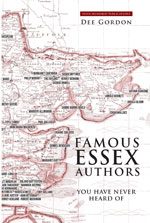
FAMOUS ESSEX AUTHORS YOU HAVE NEVER HEARD OF
BOOK DETAILS
- 154 pages, 38 illustrations plus maps showing locations of authors
- Essex Hundred Publications, 2024
- £12.99 RRP
- Available for purchase from essex100.com, from Amazon and from all good bookshops
BOOK REVIEWS
♦ “Eye-opening new book reveals how so many of history’s most successful authors have Essex links … lavishly illustrated … Dee has found a number of high-profile writers with roots in Essex, possibly unexpected names such as H.G.Wells and Mary Wollstonecraft… packed with 44 mini biographies … playwrights, Hollywood scriptwriters, and the rest…
(Southend Echo – 18.03.2024)
♦ “I loved this book. The writer obviously loves books to have discovered so many interesting unheard of Essex authors and given an insight into their fascinating backgrounds. Reading this book, my view of Essex has been changed forever – it has a rich cultural base and the fold-out map adds to the appeal of this book.“
(Amazon UK review, 19.03.2024)
♦ “Entertaining and interesting … should change the minds of literary snobs (i.e. who had not realised the breadth of Essex talent!)
(Amazon UK review, 29.03.2024)
♦ Good Read Review – January 2025

BOOK EXTRACTS
URSULA BLOOM
Ursula Bloom, long-time resident of Frinton-on-Sea, was in the Guinness Book of Records for several years as the world’s most prolific female writer, having had some 560 books published, most of them romantic novels. She also produced short stories, plays for radio and stage, and twenty non-fiction books. Her early years however were not spent in Frinton. She was born in Chelmsford, where her father was the curate of Springfield. The family moved to a rectory near Stratford-upon-Avon when Ursula was a toddler, but it appears that her father was a serial womaniser, and her mother left him before the Great War, and moved with Ursula and younger brother Joscelyn to St. Albans, which stretched them financially. A couple of years later, they found a more suitable rented house in a preferable area with a potentially healthier climate: Walton-on-the-Naze.
Ursula was home educated, and published her first book Tiger at the age of seven. By the age of eleven she was writing her own children’s magazine, distributed among friends. She was also taught the piano and the violin, the former skill meaning that she was helping to support the family finances by playing for a local cinema in Harpenden, near St. Albans, to accompany the silent films…
DANIEL DEFOE
Daniel Defoe … Born and educated in London, Defoe is descended from an old Essex family named Foe who had settled in Chadwell, near Tilbury, in the 15th century. Although his father was a prosperous candle maker, it was anticipated that Defoe would enter the nonconformist ministry, given his religious views and religious education, but in fact he followed his father into “trade”. He started as a wholesale hosier in 1681, but then, after his marriage in 1684 to Mary (a marriage which came with a generous dowry; and produced eight children), began dabbling unsuccessfully in speculative investments.
As a result, Defoe was declared bankrupt in 1692, and ended up in debtors’ prison. He managed to negotiate his way out of prison, and finally set up his own factory in Tilbury in 1694 making roof tiles and bricks on land he had already leased. Some successful years followed, with Defoe able to employ over 100 people, meaning he was able to happily settle in a residence near the banks of the Thames with fine views across the water. This was also a period when his writings became popular, and he was diverse in his works – satirical poetry, politics, the social divide, philosophical essays, and religion, the latter sometimes anonymous as it was often, crucially, in favour of those who chose to worship outside the established Church of England, i.e. the dissenters.
His 1702 publication, Shortest Way With the Dissenters, resulted in his arrest (again) for seditious libel and he was fined the equivalent (in today’s money) of over £60,000 plus a stint in the pillory, and imprisonment at Newgate. The story goes that his fine was paid, and he was released, after agreeing to becoming a secret agent for the Tories, specifically infiltrating their press! These spells of imprisonment (there was another in 1714) came at a time when his business needed his input, and when he needed a regular income to support his large family, so when he was finally released from prison, his business, his finance, and his reputation, were all damaged. In between his spells in prison, Defoe’s fame as an author grew…
I have always been interested in authors and their books – their backgrounds, their inspirations, how they write, why they write, and what they write. So, combined with my local history background, Famous Essex Authors You Have Never Heard Of was born. The book comprises more than forty mini biographies of Essex authors from the recent and distant past, too many of them now forgotten (hence the title!) along with a look at some of the big guns who have spent time in Essex e.g. Dickens. This has been a labour of love – for writers and for Essex, that under-rated county when it comes to culture.
Current authors associated with Essex are not, however, included because of how the information on these changes month on month, especially when it takes some time between writing about them and seeing that in a printed book – very different to writing about, say, Richard Osman or Martina Cole, in a newspaper that is printed say 48 hours later. Obviously the 20th century writers dominate simply because there were more of them e.g. Douglas Adams (Hitchhiker’s Guide to the Galaxy), Ruth Rendell (the Inspector Wexford novels), Dodie Smith (One Hundred and One Dalmatians), Dorothy L. Sayers (the Lord Peter Wimsey books) and John Fowles from Leigh-on-Sea (The French Lieutenant’s Woman). You will have heard of some of these, of course, but I couldn’t really leave them out!!
You will have heard of some of these, of course, but I couldn’t really leave them out!! But years of research has revealed a number of much earlier, successful, writers, dating back as far back as the 17th century, with books now only available from specialist online sources.
These include the 19th century Lady Emma Caroline Wood (Cressing and Ockendon), not published until she was in her 60s and the earlier Lady Mary Wroth (Woodford and Loughton), potentially the first female English novelist – in 1621. As members of the aristocracy, these women were well educated, but not necessarily well-heeled, needing to earn money for their families.
There are also quite a few well known writers whose roots or long term residencies have been in Essex – e.g. Arnold Bennett and William Morris in his authorial role. Essex can even boast Hollywood screen writers such as James Hilton (Goodbye, Mr Chips, etc.) and Elinor Glyn, (the raunchy Three Weeks among others) in the first half of the 20th century. Poets are included because they are so often overlooked when it comes to thinking about authors, with a special section on more famous poets who have spent time in Essex, including a reference to John Betjeman, a fan of Southend Pier. Children’s writers are not forgotten – or at least not by me. For instance, there was Richard “Roland Quiz” Quittenton from Westcliff who wrote the Tim Pippin books, among others, some the stuff of nightmares! Just as worthy of inclusion are the playwrights and scriptwriters such as the little-remembered Harriet Jay from Grays who achieved theatrical success, particularly in the U.S.A., along with the more recent Tony Holland from Shoeburyness, creator of EastEnders. This is my own personal favourite of my own books.