ESSEX LAND GIRLS
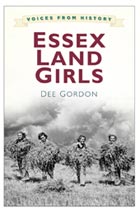
BOOK DETAILS
- 191 pages
- The History Press, March 2015
- £9.99 RRP
- Available for purchase from Amazon, Waterstones, W. H. Smith, The History Press and from all good bookshops
- Also available in Kindle format, £4.79
BOOK REVIEWS
♦ “Dee Gordon has clearly had to do a great deal of research for her latest book, but it is a story that needed to be told. There have been many books about Land Girls, but this is one devoted to their role in Essex. Essex Land Girls gives us an insight into the part they played in this area and the experiences they had.”
(Leigh Times – 02.06.2015)
♦ “Well researched book covering not one but both world wars and showing the importance of Essex Land Girls in saving the country from starvation in both conflicts. Loved the personal interviews and good use has been made of recorded interviews held at museums all over Essex and at the Imperial War Museum. Favourite anecdote? Elsie’s use of Ex-Lax to replace chocolate for the ‘conchies’ she didn’t like working with.”
(Amazon UK review – June 2015)
BOOK EXTRACTS
THE DIVERSE FACE OF THE WLA IN ESSEX (IN WORLD WAR ONE)
An October 1917 issue of the Illustrated War News describes members of the WLA as “women of leisure, daughters of professional men, women who have given up lucrative employment at their country’s call, and thrown aside the frock of peace for the brown drab overalls of war.” “Upperclass” ladies, in the Downton Abbey mould, were certainly drafted into the Land Army and often employed as grooms and stable managers at studs and racing stables, breaking and training horses for service. At the beginning of the war, paddocks at Elsenham Hall were reputedly staffed by Land Army Girls who took on horses and mules suspended from active service, and described as “incurably vicious”; these were restored to good form and returned to the fray.
There is an interesting reference to the opening of a Girls Friendly Society Hostel in “Essex Girls in War Time,” printed in the Essex Review during the First World War (Volume 27, 1918- 1919). Written by Rev F.D.Pierce, it describes the hostel as being “first for munition workers but open now to receive land workers, the first hostel in England for land workers.” The Hon. Sec. of the Girls Friendly Society War Time Fund was Miss Read of Theydon Bois.
One Land Girl (G.L.Andrews) is mentioned in the March 1918 issue of The Landswoman. She is said to be working at White’s Farm in Lamdon in Essex, although this is probably a misspelling of Laindon, and had written in response to the Correspondence Club initiative. She is among a list of “girls who want letters” so White’s must have been a lonely spot at the time.
***
Born in 1895, Doris Robinson recorded an account (for the Imperial War Museum) of working “for a strange man” on a “farm in Loughton” after just two weeks training at Little Baddow. Here she “looked after seven jersey cows, 400 hens, goats and ducks” on her own! There were some extra staff employed “at haymaking” but there were “no days off, even on Christmas day” when she was “given mouldy fruit as a Christmas gift.” The only reference she made to her uniform was to the armbands she wore, but she refers to her “lodgings with the carpenter and his wife, paying them 18s per week out of my £1 per week pay,” with another 3d payable for insurance. These lodgings were described as a “large house with nowhere to wash except in the cowshed” but she stayed there for two years until marrying in 1917. She “enjoyed working with animals” and “rode a pony, using a sack, not a saddle.” Originally from Rochdale, Doris had decided the WLA was easier than nursing, her original choice, but with “too many questions” she couldn’t answer! She spoke of the “bath in the greenhouse” and the danger of “climbing ladders” and the pain of chilblains as a result of the cold. Although “left to my own devices” she was not unhappy because she “was surrounded by creatures … I even enjoyed rounding up the ducks.”
SOME WORLD WAR TWO EXPERIENCES
MARY PAGE
“I didn’t like working in the shoe department at the Romford Co-op when war started. So three of us from the Co-op signed up to the Land Army and were all sent to be trained at Northamptonshire Agricultural College. Here we were treated like royalty, had our own room, and were very lucky. I wanted to be a tractor driver, but was pointed towards the milking parlour. My friend had little hands and was always getting kicked. I was more fortunate, with big hands which
were an asset. I found I could milk beautifully… [after training] I was pleased to be back in Essex, at a farm in Pebmarsh.”
RENE WILKINSON
In common with so many other Land Girls, Rene learnt a huge range of farming skills. She cut down “lucerne,” [also called alfalfa (livestock fodder), harvested as hay], dug ditches, pulled up sugar beet and kale, learnt how to do hedging and thatching and looked after a pig farm. She worked mainly at Stansted Hall, the estate of Rab Butler M.P., with the main house loaned out as a convalescent hostel for the Red Cross.
“Pulling kale was unpleasant in the rain [as it grew] six feet high, and I hated picking brussel sprouts in the snow. I loved fruit picking, though: raspberries, strawberries, blackberries, and working in the orchards with apples, pears and plums which you could add to the four slices you were handed for your lunch.”
She remembers “working with East Enders who believed cows to be bulls because they had horns” and that she had to drive “through the airport [Stansted] every morning, and saw the damaged aircraft.” It was the Americans who “provided waste food for the pigs” but when “they showed any interest in the girls [in the hostel], Mrs Dover drove them away.” Her main memory of the pig farm was “the smell” which she had to “wash off at the hostel’s ablutions before eating” in the evening. Rene also recalls learning to use threshing tackle (fore-runner of the combine harvester) “with a steam roller, which was always breaking down” but any downside was offset by “getting a good suntan.”
JEAN LAKIN
18-year-old Jean Lakin was probably the unluckiest Land Girl of them all. Based at Mark Hall in Harlow, she was sitting on the shaft of a horse and cart when it went through a gate, at Kitchen Hall Farm, knocking her off, with fatal consequences. The Land Girls placed a memorial in the vestry of Latton Church at Harlow, recording her death on 27th September 1944. Harlow Land Girls had been particularly unlucky, with another funeral, that of Doreen Francis, aged just 17, having taken place in February 1943. Twenty members of the WLA formed “a guard of honour” at Doreen’s funeral with Mrs Tom Howard “representing Mrs Solly Flood, the Organising Secretary of the WLA” according to the Harlow Gazette. A wreath in the shape of the WLA badge was among those in evidence.
Gas attacks were something that Land Girls prepared for, but which didn’t happen. They learnt how to deal with gassed animals, how to protect chicken coops and cowsheds with dampened sacks, and how to treat blistered cattle. Animals would have had to be led to decontamination areas, where their sores could be treated, and the girls picked up such tips as how to protect horses’ eyes: with bandages soaked in the horse’s own urine. Such a hazard threatened not only the animals, but the Land Girls themselves, but the danger diminished as the months passed.
This book not only includes interviews with some of the last surviving land girls but also contains a wealth of material unearthed in diaries, letters and in the stories handed down from one generation to the next about women in Essex who were, literally, wearing the trousers.
They were not all local girls, and many arrived from the cities never having seen a cow or a tractor before. But the British spirit persevered, and the wit and camaraderie that serves us so well during those tumultuous years shines through in every story.