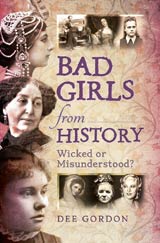
BAD GIRLS FROM HISTORY
BOOK DETAILS
- 148 pages
- Pen & Sword Publishers, Nov 2017
- £12.99 RRP
- Available from Amazon and from all good bookshops
BOOK REVIEWS
(Publishers’ Weekly Review – 09.10.2017)
♦ “Local author Dee Gordon has published her latest book which, for a change, focuses not just on local people but on a medley of international womenfolk with quite a range of interesting reputations. Bad Girls from History – Wicked or Misunderstood” has been a labour of love by a writer who has always been interested in what makes women, in particular, rebel against what is regarded as acceptable – which varies from century to century, decade to decade. … includes Camilla Parker-Bowles’s ancestor Alice Keppel (1868-1947), the most enduring of king Edward VII’s mistresses … a lot of fun …
(Leigh Times – 12.12.2017)
♦ “The author’s style is engaging and, despite the briefness of the vignettes, she manages to make these women compelling (and horrifying in some cases), and she is at pains to try and paint as balanced a picture as possible, rather than just present them according to the prevalent morality of their time. Reality and legend are sometimes difficult to tell apart, but the author, tries (and at times acknowledges defeat and provides the most interesting versions of a woman’s story available).
Among the many women in the book, I was particularly intrigued by Jane Digby (1807-1881), a lover of travel and an adventurer who also had a talent for choosing interesting men, Enriqueta Martí (1868-1913), who lived in Barcelona and who, according to recent research might not have been guilty of the horrific crimes she was accused of (I won’t talk about it in detail, but let’s say that, if it was true, she was not called The Vampire of Barcelona for nothing), Princess Caraboo (aka Mary Baker: 1791-1864), who knew how to come up with a good story, or Georgia Tann (1891-1950), that I felt intrigued by when I read that Joan Crawford (who has featured in one of my recent reads) had been one of her clients. But there are many others, and of course, this is a book that will inspire readers to do further research and look into the lives of some of these women (or even write about them).
The women in each chapter are organised in alphabetical order, and that means we jump from historical period to historical period, backward and forward, but there is enough information to allow us to get a sense of how society saw these women and how class, patronage, social status, money… influenced the way they were treated. There are personal comments by the author, but she is non-judgemental and it is impossible to read this book, especially some of the chapters, without thinking about the lot of women, about how times have changed (but not as much as we would like to think, as evidenced by recent developments and campaigns), and about how behaviours that from a modern perspective might show strength of character, intelligence, and independence, at the time could condemn a woman in the eyes of society, ruining her reputation and/or destroying her life.
A book to dip in to learn about social history and the role of women, and also one that will inspire readers to read more about some of these women (and others) that, for better or worse, have left a mark. A great starting point for further research into the topic, and a book that will make us reflect about the role of women then and now”
(Extract from a review by Olga Nunez, academic and writer/blogger on www.authortranslatorolga.com
BOOK EXTRACTS
Born in London (probably Paddington) into a working class family of German emigrants, Kitty’s beauty elevated her to the public eye by the age of seventeen. As a result, she caught the attention of some prominent figures of the day including the Prince of Wales and his brother, and – importantly – the portrait painter Sir Joshua Reynolds.
By the time she had her portrait painted (four times in all) by Sir Joshua between 1759 and 1766, she had already acquired a reputation as one of the top London courtesans. The paintings were reproduced as cheap prints for her fans to buy, some small enough to sit secretly inside a snuff box or pocket watch. From working in a milliners, she could soon afford to live in Mayfair.
Kitty’s habit of riding at some speed in St. James’s Park was frowned upon by some, and, following a fall which revealed her legs (a real shocker) and “disordered” attire, a satirical print appeared in print c. 1760 entitled “The merry accident”… Some think this could have been a publicity stunt, in line with another stunt when she sandwiched a £20 banknote between two slices of bread and actually ate it to show her disdain for such a paltry sum of money! [Some sources refer to £50 or even £100, a note first issued in 1725, but as even £20 is now worth thousands, this seems unlikely.] …
WARRISTON, LADY JEAN 1579 – 1600
From a wealthy Stirlingshire family, Jean married the much older Laird of Warriston at a very young age (exact age unproven). If contemporary accounts are to be believed, the Laird treated his wife badly, and she may well have been a victim of domestic abuse. On the other hand, there were also rumours about her relationship with a groom of her father’s, Robert Weir. Just one of many questions that linger is: who was the father of her baby, born in wedlock?
Jean’s nurse was very supportive, and apparently encouraged her to “do” something about her
abusive husband, and roped in Weir to “help”. The three met up to discuss the situation and, the same night in July, Jean managed to ensure that her husband drank excessively. Weir hid in the cellar until she felt the time right to lead him to her husband, in his bed, although woken by their arrival. There is no doubt that Weir attacked the older man with some force, killing him, but it seems that he reassured Jean that he would take the blame if murder was the verdict, escaping by fleeing the country.
Next morning, the murder was, of course, discovered, and Weir did indeed flee; but this left
Jean and her servants to face arrest. So not quite the outcome they had planned. …
GRESE, IRMA 1923 – 1945
The women who adopted the Nazi creed were often more sadistic than the men. Irma Grese was a prime example: from joining the League of German Girls (the female version of Hitler Youth) to working in the concentration camps, she revelled in her role as, eventually, the ‘beautiful beast of Belsen’.
From an unremarkable agricultural family in the village of Wrechen (North of Berlin), the attractive blonde Irma was actually sent to work at Ravensbruck camp at the age of 15 by her local Labour Exchange! Perhaps they had an insight into her personality, because she had found her calling. By 19, she was a Senior SS Supervisor there, and also worked at Auschwitz before ending up at Belsen.
In 1945, when Belsen was liberated by the British, she was one of the guards arrested. She tried pleading not guilty to the charges of murder and ill treatment of prisoners, but there was too much evidence and too many witnesses for this plea to be taken seriously. Witnesses spoke of Irma patrolling the camp with her German shepherds who were set on skeletal prisoners for any excuse and then kicked with her heavy boots until they were dead or dying. It seems she took a particular delight in whipping and slashing the breasts of women who were well-endowed, or whipping their faces if some beauty remained. Another of her pleasures was to send women on errands outside the barbed wire enclosure which meant they were shot down by guards. She claimed that the pistol she carried – in addition to the whip – was only for show, but she had been seen using it to shoot anyone who tried to escape the gas chamber lines…
Mistresses, murderers, smugglers, pirates, prostitutes and fanatics with hearts and souls that feature every shade of black (and grey!). From Cleopatra to Ruth Ellis, from Boudicca to Bonnie Parker, from Lady Caroline Lamb to Moll Cutpurse, from Jezebel to Ava Gardner … Less familiar names include Mary Jeffries, the Victorian brothel-keeper, Belle Starr, the American gambler and horse thief, La Voisin, the 17th century Queen of all Witches in France – but these are random names,
to illustrate the variety of the content in store for all those interested in women who defy law and order, for whatever reason. The risqué, the adventurous and the outrageous, the downright nasty and the downright desperate – all human (female!) life is here. From poverty stricken backgrounds to the aristocracy, class is not a common denominator. Wicked? Misunderstood? Naïve? Foolish? Predatory? Manipulative? Or just out of their time? Read … and decide.